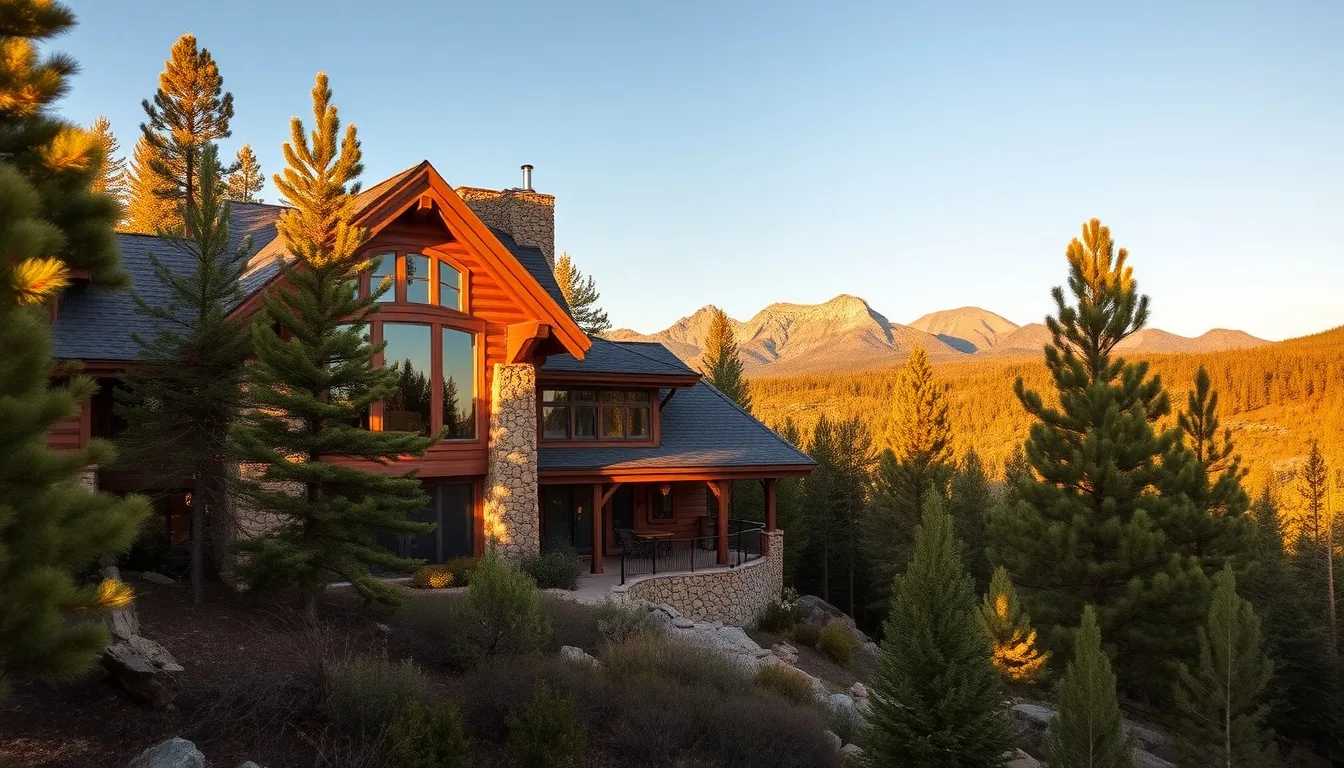
High-Value & Wildfire-Aware Home Insurance
High-Value & Wildfire-Aware Home Insurance for Northern Arizona
Homes backing Coconino, Prescott, or Tonto National Forest carry a genuinely different risk profile than a standard Arizona home. We place them factually — not with generic reassurance.
Why Standard HO-3 Policies Fail Custom Mountain and Forest-Edge Homes
A stock HO-3 policy is built around a default rebuild-cost calculator, a standard valuation model, and an assumption that the biggest risk to the structure is fire from inside the home. None of that holds up well for a custom log or timber-frame home on a forested Flagstaff lot, a view property in the Bradshaw Mountains outside Prescott, or a cabin backed directly against the Tonto National Forest near Payson.
These homes sit exactly where national forest boundary meets private property — the classic wildland-urban interface (WUI) — and carriers increasingly score that boundary distance, slope, vegetation density, and access road width house by house, not by city or ZIP code. A standard policy priced off a generic Arizona template routinely underinsures the rebuild and misses the wildfire-specific coverage these homes actually need.
This matters because the WUI isn't a fringe category here — it describes a meaningful share of the housing stock across all three hub areas. Flagstaff's forest-edge neighborhoods back Coconino National Forest directly; Prescott and Prescott Valley sit against the Bradshaw Mountains and Prescott National Forest boundary; and in Gila County, over 95% of the land is public or tribal, which puts nearly every Rim Country home somewhere on the WUI spectrum. A one-size-fits-all policy written without that context is starting from the wrong assumptions.
Extended and Guaranteed Replacement Cost Across a Variable Rebuild Market
Rebuild costs vary sharply across the corridor — a custom home's rebuild cost in Flagstaff, Prescott, and Payson reflects three different labor markets, material logistics chains, and contractor availability, and that gap widens further after a regional wildfire pushes demand and pricing up all at once. A default replacement-cost estimate written at policy inception rarely holds three or five years later.
Extended or guaranteed replacement cost is the single most important upgrade on a custom or forest-perimeter home policy. It closes the gap between what a policy was priced for and what a real post-disaster rebuild costs, and it's typically only available through the high-value and specialty carrier tier — not the standard admitted market.
Custom Features That Change the Underwriting
Log and timber-frame construction, large view lots with limited access, and forested parcels requiring active defensible-space management all raise both rebuild cost and wildfire exposure at the same time — and a generic policy application often doesn't even ask about them. A standard intake form built for a tract home in Phoenix has no field for roof pitch on a timber-frame lodge, or for how many vehicles a single-lane forest access road can actually clear during an evacuation.
This is second-home and seasonal-occupancy territory as often as not. Flagstaff's ski and college-town economy and Payson's cabin country both carry a genuine population of homes that sit vacant for stretches of the year, and occupancy pattern is a core underwriting question that a standard application frequently glosses over — extended vacancy on a policy written as full-time occupied can suspend key coverages exactly when a slow leak or break-in happens.
- Log, timber-frame, and other custom construction types requiring specialty valuation
- Large or steep view lots with limited or single-access roads
- Forested lots requiring documented, maintained defensible-space zones
- Detached studios, guest casitas, and outbuildings common on larger mountain parcels
- Well and septic systems in place of municipal utilities on more remote properties
Wildfire Services From Premium Carriers
Some high-net-worth carriers do something standard insurers don't: they intervene before a fire reaches the property. Enrolled homes can receive private wildfire-response services — pre-treatment with fire retardant, gutter and combustible-material clearing, and on-the-ground monitoring during an active fire in the area — along with meaningful pricing credit for documented defensible-space work and Firewise-adjacent mitigation.
These services aren't available on every policy or in every carrier's current appetite, and appetite shifts by season and by how recently a given area has burned. We check current wildfire-service availability at every renewal for corridor homes, not just at initial placement.
Cash Settlement and Rebuild-Elsewhere Options After a Total Loss
After a total loss, some premium carriers offer a cash-settlement option instead of requiring the owner to rebuild on the same forested lot — a meaningful choice for a homeowner who no longer wants to rebuild in a location with elevated recurring wildfire exposure. This option is not universal and needs to be confirmed on the specific policy before it's needed, not assumed after a loss.
We review settlement options as part of every high-value and wildfire-zone placement, and we tell clients plainly which carriers offer this flexibility and which don't — this is a factual comparison point, not a marketing feature every policy includes.
High-Net-Worth Carriers vs. Surplus Lines for Forest-Perimeter Homes
The high-net-worth carrier tier — the Chubb, PURE, and Cincinnati class of market — will write many forest-perimeter homes that standard carriers won't, at pricing that's often closer to standard-market rates than owners expect, especially once defensible-space credits apply. But some homes — canyon-edge lots, single-access roads, heavy fuel loads close to the structure — get declined even by that tier.
Because Arizona has no FAIR Plan, the fallback for those homes is the surplus-lines (E&S) market, typically 20–50% above standard pricing with narrower terms. We quote the high-net-worth admitted market first on every forest-perimeter home, and only move to E&S placement when appetite there is genuinely exhausted — negotiating wildfire deductibles and valuation language rather than accepting a wholesaler's first quote.
This is a corridor-wide reality, not a Flagstaff-only concern. A Prescott-area property near the Goodwin Fire's 2017 burn footprint and a Payson cabin inside the Tonto National Forest perimeter face the same three-tier placement path — admitted, high-net-worth specialty, then E&S — even though the underlying fire history and vegetation type differ from site to site.
Pairing With Umbrella Coverage
A high-value or custom mountain home usually sits alongside meaningful other assets, and liability claims target assets, not just the property. A guest injury on a steep deck or trail, a dog bite, a serious auto accident on a mountain highway — verdicts can clear the liability limits on even a well-built home policy.
A personal umbrella adds $1M–$10M of liability above the home, auto, and any landlord policies in the household, typically for a few hundred dollars per million per year — one of the least expensive meaningful protections available for a corridor homeowner with real assets to protect.
A Confidential, Documentation-Driven Quote Process
Quoting a custom or forest-perimeter home is discreet and document-based: square footage and construction detail, distance to the forest boundary, roof age and rating, defensible-space status with dated photos, occupancy pattern (primary, seasonal, or second home), and any current declarations page for a line-by-line comparison.
We'll tell you plainly where a given home stands — which carriers are actively writing that street this quarter, which have pulled back since the last local fire, and whether E&S placement is likely before we ever submit an application. That upfront honesty is deliberate: a wildfire-zone quote process built on false reassurance wastes time and, worse, leaves a homeowner unprepared for a non-renewal that was foreseeable.
Call 844-967-5247 or email josh@contractorschoiceagency.com to start. We place high-value and wildfire-zone homes across Flagstaff, Prescott, Prescott Valley, and Payson/Rim Country, and also serve Sedona and the Verde Valley.
Wildfire-Aware / High-Value Home FAQs
Honest answers before you switch
Yes, across the whole corridor. Flagstaff, Prescott, and Payson all sit at the edge of national forest land — Coconino, Prescott, and Tonto National Forests respectively — the classic wildland-urban interface (WUI) that drives both wildfire likelihood and insurance non-renewal risk. Carriers score homes individually based on proximity to forest boundary, slope, and vegetation, not just city or ZIP code, so two homes on the same street can be scored very differently.
Flagstaff: the Museum Fire (2019, ~1,800 acres), the Tunnel Fire (April 2022, 700+ homes evacuated, 30 structures destroyed), and the Pipeline Fire (June 2022, 5,000+ acres, re-burned part of the Tunnel Fire's footprint). Prescott/Yavapai County: the Goodwin Fire (2017, 28,516 acres, 17 homes destroyed, roughly $15M in damage) and the Doce Fire (2013, ~7,000 acres). Rim Country/White Mountains: the Rodeo-Chediski Fire (2002, 462,600+ acres, the largest wildfire in Arizona history at the time, ~30,000 evacuated), plus the Dude Fire (1990), Bush Fire (2020), and Backbone Fire (2021). Wildfire here is a recurring regional event, not a hypothetical.
Don't let coverage lapse — a lapse makes replacement harder and more expensive. We re-shop admitted carriers first, then high-net-worth and surplus-lines markets that write wildfire-zone homes. Statewide non-renewal is low overall (about 0.8% in 2023) but concentrates sharply in forested counties — Gila County hit roughly 2.5% in 2022, Navajo County reached 4.8% in a single post-fire-season year — so a non-renewal notice on a forest-perimeter home is a real, not rare, outcome.
No. Arizona has no FAIR Plan or state-backed insurer of last resort. If both standard and high-net-worth carriers decline a home, the only remaining path is the excess & surplus (E&S) market, typically 20–50% more expensive with narrower terms.
It can, but it isn't a guarantee. Defensible space is the cleared or thinned buffer zone around a structure, typically graded in immediate, intermediate, and extended zones. Several carriers give pricing or eligibility credit for documented, dated mitigation work, and some will write homes they'd otherwise decline if that documentation exists — but mitigation doesn't override every underwriting factor, and a home with a poor access road or heavy surrounding fuel load may still be declined by the admitted market regardless of defensible-space work.
Living in the high country deserves coverage that gets it.
Independent, local-minded insurance for Flagstaff, Prescott, Sedona, and Payson — homeowners, auto, business, and more.